

Tucked away at the end of All Souls Lane, off Huntingdon Road, is the small Ascension Parish Burial Ground. You’re unlikely to stumble upon it; it’s set back from the main road. A friend mentioned that the great Austrian philosopher Ludwig Wittgenstein is buried there, and I went looking. Once you know, it’s easy to find—a hidden gem, like so many places in Cambridge.
In 2007, the cemetery was given over to wilding. Nature now takes its course, except about once a month, when friends of the cemetery trim ivy and brambles so gravestones remain visible. Trees grow on and around the tilting headstones, unseen furry creatures hide in holes, and small animals, like the snail in my photograph, creep undisturbed. A place set aside for the dead, teeming with life.
A place set aside for the dead, teeming with life.
I like cemeteries. Some people associate them with Halloween and other gothic imaginings; for me, they are quiet and peaceful—places to show respect for lives once lived and to contemplate my own mortality. I accept that I will die one day—until I actually face it, as when a doctor calls with a bad test result, and I am suddenly afraid and not ready.
Ascension Parish Burial Ground was built in response to cholera epidemics in the mid-1800s. Since cholera was thought to be caused by miasma (bad air, like the smell of rotting corpses), Parliament’s Burial Acts of 1852 and 1853 pushed new burial grounds out of town. Accordingly, in 1857, the Cambridge Parish Burial Ground Committee purchased two acres of land (enlarged around 1930, when the original ground was full) from the Bishop of Ely for £374 15s 8d. At first called St Giles’s and St Peter’s Burial Ground, it was renamed Ascension Parish Burial Ground in 1971, after the two parishes formally merged. The first burial was in 1869; the cemetery closed to new burials in 2020. In all, about 2,500 people lie here in 1,500 graves—a discrepancy explained by the English habit of stacking coffins, one on top of another, up to five deep.
Most of those buried here came from the surrounding suburbs. Until about 1870, the medieval West Fields beyond the Backs, owned mostly by St John’s College, remained undeveloped. Then two changes filled them with houses: an agricultural depression that left St John’s short on rent, and an 1882 statute that let dons marry without giving up their fellowships. Family homes rose along Grange Road and Madingley Road (St John’s kept out the riffraff with minimum lot sizes and building costs) and, from 1911, along Storey’s Way, where Wittgenstein would die. Because the new homes lay in the parish of St Giles, many of these university elites would one day be buried here.
Wander the paths of the cemetery, and you meet the dead the way you’d meet neighbors—first by proximity, then by story.
Just within the cemetery gates, by the chapel of rest, lie Sir James George Frazer, author of The Golden Bough; Sir John Cockcroft, the first of our three Nobel laureates, who split the atom; and G. E. Moore, Professor of Philosophy. Remember Moore; we’ll meet him again.
Walking the perimeter path, we find the graves of Sir Max Perutz, our second Nobel laureate, who revealed the structure of proteins; and John Couch Adams, who found Neptune with pen and paper and turned down a knighthood, preferring a quieter life (he lived and died at the Cambridge Observatory). We then come upon the Darwins, five of them: Sir Francis, a son of Charles, who shares his grave with his daughter, the poet Frances Cornford; his brother Sir Horace and Horace’s wife, Lady Ida; and Francis’s third wife, Lady Florence. A little farther along the path is our third Nobel laureate, Sir Frederick Gowland Hopkins, discoverer of vitamins.
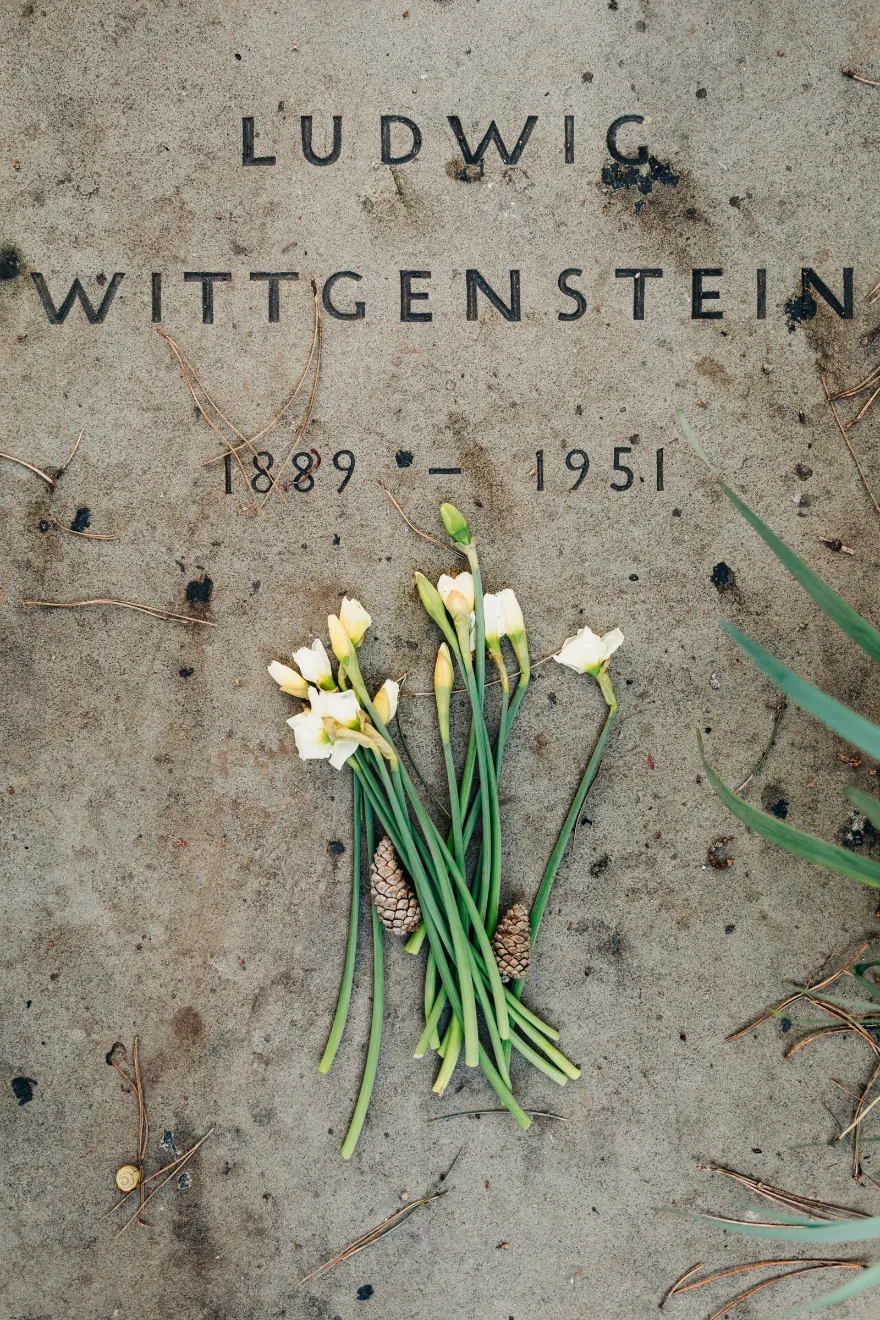
The grave I set out to find is near the middle of the cemetery—a flat sandstone ledger that reads LUDWIG WITTGENSTEIN 1889–1951. At its corner lies his student and literary executor, Elizabeth “G. E. M.” Anscombe, her stone equally plain. Against the cemetery’s back wall is the grave of Frank P. Ramsey, who translated Wittgenstein’s Tractatus while still an undergraduate and died at twenty-six. In death, as in life, Wittgenstein is among friends: Moore by the chapel, Ramsey by the wall, Anscombe at his side. To call Moore and Wittgenstein friends may be too generous; still, their paths crossed again and again, sometimes contentiously.
Wittgenstein arrived at Trinity College, Cambridge, in 1911 to study philosophy under Bertrand Russell. Moore was one of his lecturers. In the spring of 1914, while working alone in Norway, Wittgenstein summoned Moore, who, somewhat reluctantly, spent two weeks taking down Wittgenstein’s ideas by dictation. Wittgenstein hoped these notes would earn him his bachelor’s degree, but back in Cambridge, Moore refused him, citing university regulations (his dissertation lacked a preface and sources). On May 7, Wittgenstein penned a furious reply: “If I am not worth your making an exception for me even in some STUPID details then I may as well go to HELL directly; and if I am worth it and you don’t do it then—by God—you might go there.” Moore, deeply hurt, did not reply. They would not meet again for fifteen years.
I would rather not go there either. Not to hell, or Hell, or HELL.
That summer, war broke out, and Wittgenstein joined the Austrian army. He carried the ideas of his rejected dissertation with him and wrote much of his book, Tractatus Logico-Philosophicus, at the front. Captured by the Italians in November 1918, he sent the manuscript to Russell from the prison camp. (Wittgenstein’s Cambridge friend, John Maynard Keynes, used his government connections to get the manuscript out of Italy.) Tractatus was published in German in 1921 and in English in 1922, translated largely by Ramsey.
I own an English copy of Tractatus. I’ve tried (and failed) to read it. It runs to 75 pages of cryptic, numbered propositions. I asked my son for help, since he has a philosophy degree. Apparently, Tractatus is both very simple and very complicated. It is not a thesis moving toward a conclusion but a list, in which each point stands on its own, with Wittgenstein’s picture theory of language at its heart—that words stand in for objects and sentences mirror facts. As a photographer, I like this: a sentence as a kind of photograph of the world. The model breaks down, however, when it meets non-factual subjects like metaphysics and death—as does, by its own logic, Tractatus itself. Anyone who understands Tractatus, Wittgenstein claims, knows it is nonsense—like a ladder to be climbed, then thrown away. The book ends, “Whereof one cannot speak, thereof one must be silent.” His gravestone is fittingly plain. I feel slightly chastened, for here I am, speaking of what I cannot understand.
As a photographer, I like this: a sentence as a kind of photograph of the world.
After the war, convinced that Tractatus had solved philosophy, Wittgenstein gave it up to teach in Austrian village schools. Ramsey visited him there in 1923, pressed him on problems in the book, and coaxed him back toward philosophy. Wittgenstein returned to Cambridge in January 1929, met by Keynes. “Well, God has arrived,” wrote Keynes to his wife. “I met him on the 5.15 train.” By happenstance, Moore was also on the train—the first time the two had met in fifteen years. This time there was no quarrel. Wittgenstein submitted Tractatus as his doctoral thesis, with Ramsey, fourteen years his junior, as his supervisor and Moore and Russell as his examiners. After a successful defense, Moore reported: “I myself consider that this is a work of genius; but, even if I am completely mistaken and it is nothing of the sort, it is well above the standard required for the Ph.D. degree.” Wittgenstein’s humble reply to both men? “Don’t worry, I know you’ll never understand it.”
Moore, it seems, did not mind. When Wittgenstein began lecturing in 1930, Moore—by then in his late fifties and Professor of Philosophy—sat among the students, week after week for three years, trying to record Wittgenstein’s exact words. He admitted he never quite understood them.
After the Nazi annexation of Austria in 1938, Wittgenstein (who had Jewish ancestry) sought British citizenship. In 1939, he became both a British citizen and Professor of Philosophy at Cambridge (Moore, aged 65, had reached the compulsory age of retirement). He was not happy: “Everything about the place repels me,” he wrote. “The stiffness, the artificiality, the self-satisfaction of the people. The university atmosphere nauseates me.” During World War II, he worked incognito as a hospital porter, first in London, then Newcastle. In the 1940s, Elizabeth Anscombe attended his lectures, becoming a devotee and one of his closest friends.
In 1947, he resigned the professorship to travel and write, continuing to visit and talk philosophy with Moore. Moore had suffered a stroke, and his wife, on doctor’s orders that he not become too excited or fatigued, restricted his philosophical conversations to an hour and a half. Wittgenstein was infuriated: Moore should argue as long as he liked, and dying mid-argument would be a decent way to go—with his boots on. Moore did not “go” until 1958, aged 84. I’d settle for that.
In February 1951, Wittgenstein returned to Cambridge one last time, very ill with prostate cancer, to die at his doctor’s house at 76 Storey’s Way. Anscombe was among the friends at his bedside. When told he was about to die, he replied, “Good.” He was 62. Two days earlier, he had still been writing philosophy. Boots on, so to speak.
Philosophical Investigations, published in 1953 after his death (translated by Anscombe), is a dead man talking. In it, Wittgenstein repudiates much of Tractatus. Language isn’t about pictures after all; it is a game. Words are like pieces in a game of chess: what matters is how a piece moves and what follows from the position the piece has taken. Words have meaning only within a shared “form of life” (the practices we have in common). If a lion could talk, Wittgenstein argues, we could not understand it, for we do not share its form of life. The rules of the game are as varied as the people who play it. Again, I turned to my son. By way of explanation, he asked, “Why do you play Monopoly?” I said I didn’t know, which, apparently, is the point, and I am none the wiser. At some stage the explanations run out; all I can say is this is what we do.
The dead don’t rejoin the game we play; they can only leave their words behind, which the living carry back into the fray. So it is that a philosopher who died in 1951 is still debated in lecture halls around the world, and by my son, and now by me. If the dead could talk, given their new “form of life,” would we understand them any better than we could the lion?
Walking here, among the ivy and the creeping things and the brilliant dead—the man who refused a knighthood, five Darwins, the professor who sat among the students, a genius philosopher—I contemplate their silence. Death, Wittgenstein writes in Tractatus, is not an event in life; we do not live to experience death. It is the thing of which we cannot speak.
I am not ready to be silent. When the doctor calls with the last bad news, I doubt my answer will be “Good.” For now, I’m still in the game.