


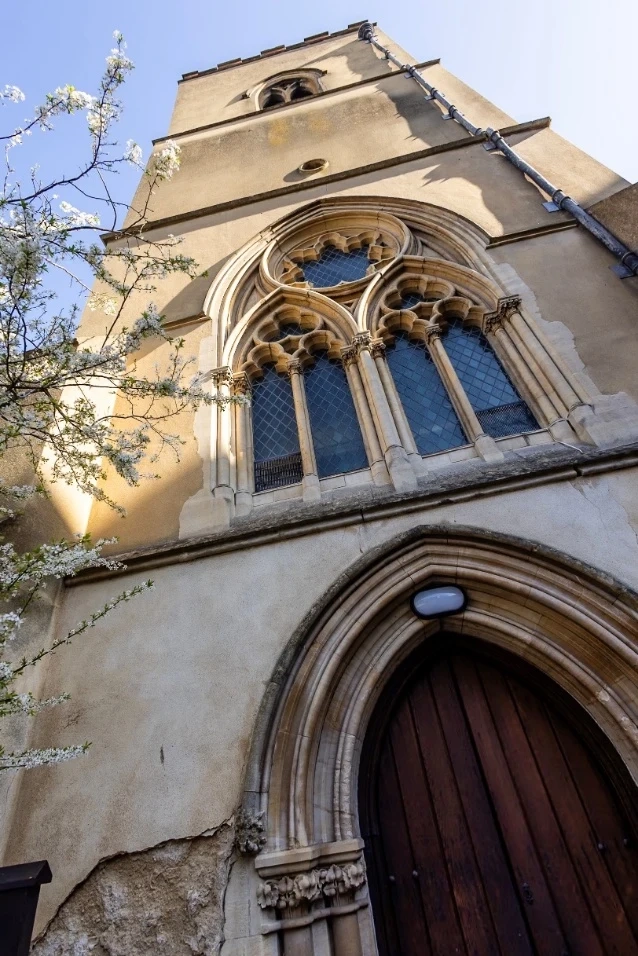
In the heart of Cambridge stands a small parish church dedicated to Saint Edward, King and Martyr. It has the tiniest churchyard and an old, old tower. The tower was built around 1200 and remains essentially unchanged, except for a few upgrades, like Victorian cement render and a brick parapet. Around the church winds Saint Edward’s Passage—a Y-shaped alley between King’s Parade and Peas Hill. Standing in this passage, before the west door of the church, I lift my camera to frame my shot.
Through the viewfinder, the tower is already a fragment: only the west side, its verticals leaning inward through my wide-angle lens. I decide what goes in the frame and what stays out. The words in this essay are a fragment too, framed by someone’s choices—mine, and those of the chroniclers who came before me—for Edward’s story is over a thousand years old.
No founding documents survive, but the church was probably dedicated at the height of the cult of Saint Edward, King and Martyr, in the eleventh and early twelfth centuries, when medieval worship centered on the veneration of saints, with feast days—Saint Edward’s is 18 March, the day of his death—relics, shrines, pilgrimages, miracles, and dedications.
Many King Edwards have worn the English crown. The later Edwards are told apart by regnal numbers (Edward I, known as Longshanks, through Edward VIII)—a habit that took hold only after the Norman Conquest (William the Conqueror became William I only once there was a William II). When the count of Edwards began in 1272, it started from scratch, as if the three Saxon Edwards had never worn the crown. Early kings have epithets, usually bestowed after death, that highlight a quality or deed. From such epithets, we learn that Alfred was great, as the Victorians decided, that Edgar was peaceful, and that Sweyn had a forkbeard. Epithets did not die out after the Conquest, and they were not always kind. Bloody Mary’s epithet is a Protestant invention; she might not approve.
At birth, in 962, our Edward was merely a prince. In 975, at about age thirteen, he took the throne. Three years later, he was stabbed in the back; the murder has never been solved. Since kings were appointed by God, to kill one was sacrilege, breaking Christian law—or so his cult argued in counting Edward a martyr. In 1001, the many miracles attributed to him made him a saint. And because heavenly saints outrank earthly kings, he is called Saint Edward, King and Martyr. Three epithets—all complimentary. It could be worse (ask Mary).
Our Edward is the great-great-grandson of Alfred the Great of the House of Wessex. Between these two are six other kings across three generations and a treasure trove of epithets. The first is Edward the Elder, Alfred’s son, whose epithet is a bit sad, since it serves only to distinguish him from our Edward (would you like your epithet to depend on someone else’s story?). Then come Aethelstan the Glorious, Edmund the Magnificent, and Eadred, who has no epithet, though he did expel the Viking Eric Bloodaxe (Viking epithets are the best). Next come Eadwig the Fair (named for his good looks, not his temperament) and Edgar the Peaceful, father of our Edward.
Edgar the Peaceful earned his epithet for avoiding foreign wars (skirmishes with the Scots don’t count), though at home his reign was turbulent. Edgar angered his lords by donating their land to Benedictine monasteries. His son, our Edward, inherited his father’s crown and his enemies. Edward’s short reign was inconsequential, except for how it ended. A detective working the case would ask who stood to benefit most and quickly suspect his next-in-line half-brother, Aethelred, but Aethelred was only a child. Suspicion then fell on Aethelred’s mother. By the time of Edward’s hagiography, about a century later, she was firmly cast as the villain.
A hagiography is an idealized life story of a saint—a frame built to make its subject holy, much as I build a frame to make Saint Edward’s tower feel grander than it is. In fact, it stands only seventy feet tall, which is fairly short for a church tower. An epithet works the same way in miniature: a one-word frame that flatters its subject—or, if you are Mary, condemns her.
A hagiography is an idealized life story of a saint—a frame built to make its subject holy.
Saint George and the Dragon is a famous hagiography; obviously (spoiler alert), George didn’t fight a real dragon. Edward’s hagiography, as William Caxton retold it in the Golden Legend in 1483, states that Edward was stabbed in the heart at Corfe by his wicked stepmother. She didn’t wield the knife directly: the butler did (honestly, this is exactly what the text says). Aethelred then succeeded him, and Edward’s body was hastily buried in the desolate woods. After great sorrow among all the people, men found Edward’s grave (marked by a pillar of heavenly fire), secretly dug him up, for they feared the queen, and placed him in a chapel in Wareham. After two years and many miracles, the body was moved again, this time to Shaftesbury Abbey. When Aethelred’s mother saw the many miracles attributed to Edward, she repented of her wickedness and became good. Then Edward himself appeared to a holy man, requesting a more worshipful place, and a shrine was built. Afterward, another miracle—Edward’s uncovered body smelled so sweet that everyone was greatly comforted!
A suspiciously tidy life. Not everyone told it that way: in 1014, Wulfstan, Archbishop of York and Aethelred’s close advisor, preached that Edward had been betrayed, killed, and then burned.
Five hundred years later, in 1539, Henry VIII reversed Edgar the Peaceful’s land-distribution policy, seizing the monasteries’ lands for the Crown and selling most of them on to nobles and gentry. Shaftesbury Abbey fell into ruin, with its relics destroyed, scattered, and hidden. Nearly four hundred years later, in 1931, amateur archaeologist John Wilson-Claridge, whose father had purchased Shaftesbury Abbey land, discovered bones in a makeshift lead box. An expert later examined the bones and concluded they probably belonged to our Edward, though the identification has never been settled. The bones were enshrined in 1984 in a church in Brookwood, Surrey, owned by the Russian Orthodox Church in Exile, then spent years in a bank vault while the courts argued over ownership.
Ashes or bones: the two versions cannot both be true. Wulfstan, being closer to the action, seems more reliable, though perhaps not wholly so, given his king’s posthumous epithet, Aethelred the Unready. Unready for the Vikings, you might think, since they unseated him—but the Old English unræd means “no counsel,” a pun on Æthelræd, “noble counsel.” And Wulfstan was the counsel.
The Vikings did not wait for better counsel. In 1013, Sweyn Forkbeard drove Aethelred into exile, and Sweyn’s son Cnut soon took the throne (and, insultingly, Aethelred’s widow). The House of Wessex returned in 1042 with yet another Edward and yet another saint: Edward the Confessor, the more famous Saint Edward, and easily confused with ours. Then, in 1066, William the Bastard, great-great-great-grandson of the Viking Rollo, conquered England, thereby improving his epithet. One way or another, the Vikings won. (My grandfather was a Dane; I count myself on the winning side.)
Poor Saint Edward, King and Martyr—no Viking blood and no control over his story. I flatter myself that I have more control over how I’ll be remembered. I am no king, for a start. Nor am I a saint, though I do try to be good, and I certainly don’t want a hagiography. And if I have any say in my exit, I’ll not be a martyr either, preferring to go quietly in my sleep at a ripe old age.
Maybe I have less control over my story than I think. Even I can’t tell it reliably. Recently, I watched a short video of myself as a young child, dancing Ring Around the Rosie with friends, laughing as we tumbled to the ground. (The rhyme, despite what we were told, has nothing to do with the plague; that story, too, was added later.) I have no memory of it at all. The little girl is plainly happy, and I am glad for her, but I must take her word for it; the camera remembers what I don’t. And those who do tell my story will speak from their own equally unreliable perspectives. If only memory were as stable as this medieval church tower, unchanged by opinion and time.
The little girl is plainly happy, and I am glad for her, but I must take her word for it; the camera remembers what I don’t.
Standing in Saint Edward’s Passage, camera raised, thinking about epithets, I try one on: Jane the Photographer. It probably won’t stick. I don’t expect to be remembered past a couple of generations. Besides, we have surnames now, and kings have numbers. Not our Edward, though: three titles, no number.
Instead, he has this tower. His body may be ash, or it may be in Surrey; his life survives mainly in a story written to make him holy, which is to say, it is probably wrong. But the tower has stood in Cambridge for eight hundred years with his name on it, mostly unchanged. Perhaps that is the most any of us can hope for: not to be remembered accurately, but to be remembered somewhere solid.
I press the shutter. The verticals converge, and seventy squat feet of tower look tall and eternal. It is an illusion, a small act of idealizing, exactly what Edward’s hagiographer did to his life, and so my photograph is a hagiography too: it flatters the tower, and the tower stands in for Edward. I said I didn’t want a hagiography, and I don’t—not for myself. But having spent all this time seeing through other people’s flattering frames, here I am, making one of my own.